
Retatrutide in 2026: Where the Science Actually Stands
The GLP-1/GIP/glucagon tri-agonist with the largest Phase 2 weight-loss numbers ever reported, and where TRIUMPH Phase 3 has taken it heading into 2026.
TL;DR, Retatrutide in 2026
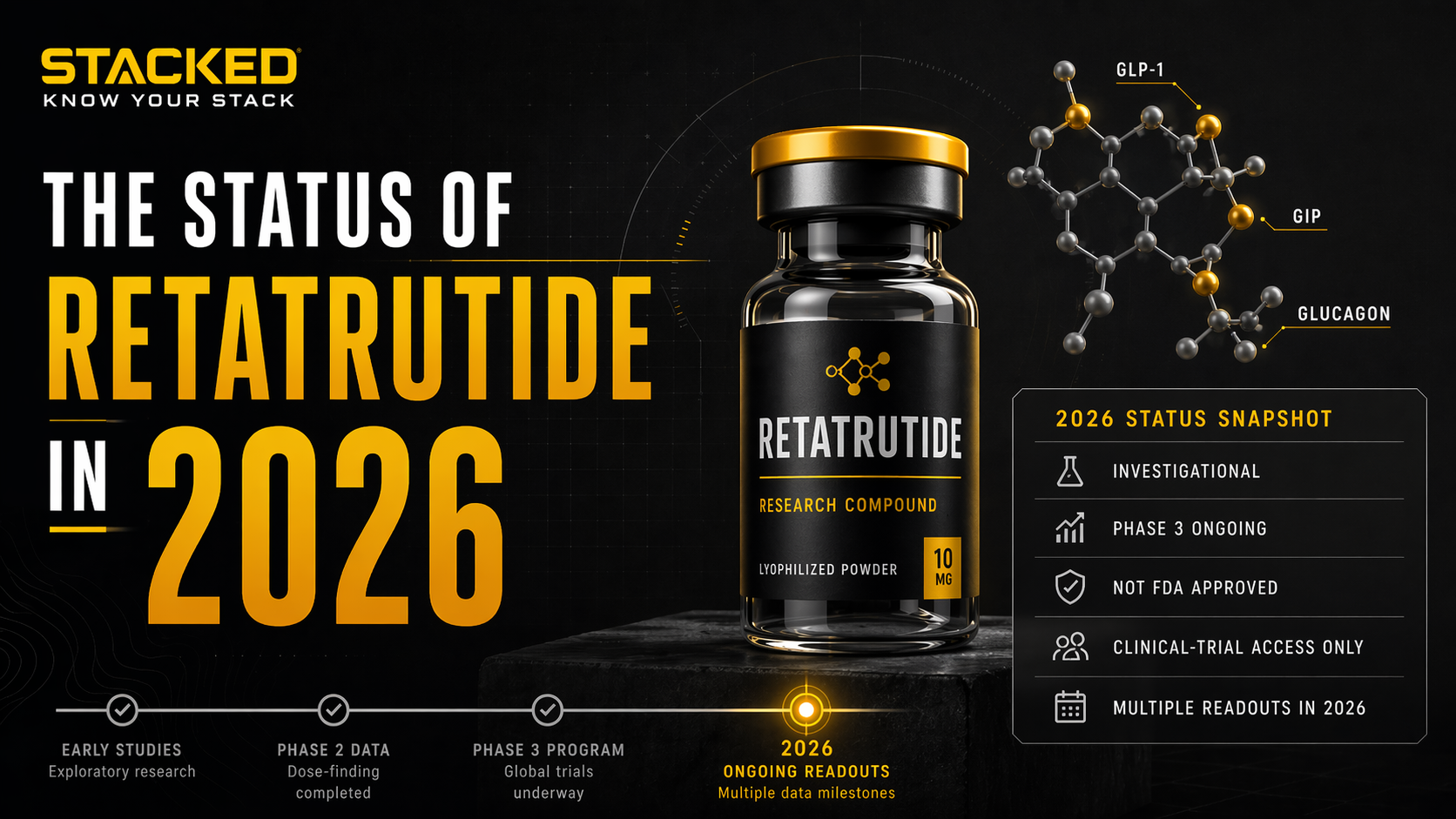
- Status: Still investigational. Eli Lilly's Phase 3 TRIUMPH program continues to enroll and read out; no FDA approval yet.
- Peak weight loss: Approximately -24.2% mean body weight at 12mg weekly over 48 weeks in the Phase 2 trial (Jastreboff et al., NEJM 2023), the largest Phase 2 weight-loss result ever reported for an incretin.
- Mechanism: Triple agonist, GLP-1 + GIP + glucagon. The glucagon arm is what pushes efficacy past tirzepatide (dual GIP/GLP-1) in Phase 2.
- MASH / liver: >80% relative reduction in hepatic fat at 24 weeks in Sanyal 2024, the strongest hepatic-fat signal in the class.
- Regulatory timeline: First FDA submission anticipated in the 2026-2027 window; approval plausibly 2027 or later, pending TRIUMPH read-outs.
- Research-chemical market: 7 of our 9 tracked vendors carry retatrutide, with per-mg pricing ranging from roughly $5-$18/mg depending on vial size and vendor.
One-line summary: Retatrutide has the most impressive Phase 2 data of any incretin ever trialed, but until Phase 3 read-outs and FDA approval land, it remains investigational. Research-chemical sources are not pharmaceutical-grade and are not appropriate for self-administration.
What Retatrutide Is, Briefly
Retatrutide (development code LY3437943) is Eli Lilly's triple-hormone-receptor agonist, engineered to activate three related metabolic receptors simultaneously:
- GLP-1 receptor, glucose-dependent insulin secretion, appetite suppression, gastric emptying
- GIP receptor, insulin sensitization, adipose signaling
- Glucagon receptor, hepatic glucose output, lipolysis, increased energy expenditure
The glucagon arm is what distinguishes retatrutide from every approved GLP-class therapy. Semaglutide is single-receptor (GLP-1); tirzepatide is dual (GIP + GLP-1). Retatrutide stacks glucagon on top of both, borrowing a mechanism, increased basal energy expenditure, that the GLP-1 and GIP arms can't deliver on their own. The clinical consequence is the largest weight-loss numbers the incretin class has produced in Phase 2.
Full profile: /peptides/retatrutide. Live vendor pricing: /price/retatrutide.
The Clinical Development Program in 2026
Eli Lilly's Phase 3 program for retatrutide is branded TRIUMPH (matching the SURMOUNT branding they used for tirzepatide's obesity program). As of early 2026, the publicly registered TRIUMPH trials span five indications:
| Trial | Indication | Status entering 2026 |
|---|---|---|
| TRIUMPH-1 | Obesity | Phase 3, enrolled, read-outs expected 2026 |
| TRIUMPH-2 | Obesity + obstructive sleep apnea | Phase 3, enrolled |
| TRIUMPH-3 | Obesity + established cardiovascular disease | Phase 3, enrolled |
| TRIUMPH-4 | Obesity + knee osteoarthritis | Phase 3, enrolled |
| TRIUMPH-OUTCOMES | Major adverse CV events (MACE) | Phase 3, enrolled, long horizon (2027+ completion) |
A separate MASH (metabolic dysfunction-associated steatohepatitis) Phase 2b trial (Sanyal et al. 2024) reported an unusually strong hepatic-fat signal and has set up a likely Phase 3 MASH trial under a parallel naming convention.
What's different from 2025. The headline 2026 change is that the first TRIUMPH-1 read-outs are imminent, which means the obesity indication moves from "Phase 2 data only" to "Phase 3 data likely this year." Investors and clinicians have been anchoring expectations against the Phase 2 -24% figure; whether TRIUMPH-1 replicates that at scale is the defining open question of the year for this molecule.
Phase 2 Efficacy, Where the Numbers Came From
The Phase 2 obesity trial (Jastreboff AM et al., NEJM 2023, PMID 37366315) randomized 338 adults with obesity and no diabetes to retatrutide at 1, 4, 8, or 12mg weekly versus placebo for 48 weeks.
Weight loss at 48 weeks:
- Placebo: -2.1%
- Retatrutide 1mg: -8.7%
- Retatrutide 4mg: -17.1%
- Retatrutide 8mg: -22.8%
- Retatrutide 12mg: -24.2% (≈ 50 lb for a 200 lb patient)
At the 12mg dose, 100% of completers lost at least 5%, ~93% lost at least 10%, and ~63% lost at least 20%. No incretin had ever reported numbers like that before the readout. Weight-loss curves had not clearly plateaued at 48 weeks, which suggested the asymptote might be still lower.
A parallel Phase 2 trial in type 2 diabetes (Rosenstock J et al., Lancet 2023, PMID 37366672) showed HbA1c reductions of up to -2.0% and weight losses up to -16.9% at 12mg over 36 weeks, competitive with tirzepatide's best T2D results in less time.
MASH / hepatic fat (Sanyal AJ et al. 2024, Phase 2b): retatrutide 8mg produced a >80% relative reduction in hepatic fat at 24 weeks in patients with MASLD, the strongest published hepatic-fat signal in the incretin class. For context, tirzepatide's SYNERGY-NASH readout landed in the 40-60% range and survodutide's Phase 2 MASH data fell in a similar band.
Side Effects, What Phase 2 Showed
The safety profile is a slightly more aggressive version of the GLP-1 class profile:
- GI-dominated. Nausea, vomiting, diarrhea, and constipation. Titration-related. Worst in the first 4-8 weeks of up-titration.
- Heart rate increases of roughly 5-9 bpm at the higher doses (8 / 12 mg). This is larger than what's seen with tirzepatide or semaglutide and is attributed to the glucagon arm. Long-term cardiovascular significance is a primary question TRIUMPH-OUTCOMES is designed to answer.
- Hepatic enzymes. Small, transient elevations during titration in a minority of participants. Notable given retatrutide's strong hepatic-fat reduction signal, the liver is being asked to do more, and regulatory review will scrutinize this closely.
- Hypoglycemia is rare on the monotherapy label but rises with concurrent insulin or sulfonylureas (class behavior).
- Injection-site reactions modest and comparable to tirzepatide.
The class-wide boxed warning around thyroid C-cell tumors (rodent finding, unclear human relevance) applies. Class-wide contraindications: personal or family history of medullary thyroid carcinoma, MEN2, pregnancy, history of pancreatitis.
Protocols in Published Research
Phase 2 and Phase 3 trials titrate every 2-4 weeks in increments small enough to keep GI side effects manageable:
- Obesity Phase 2: 2mg for 2 weeks → 4mg for 2 weeks → 6mg for 2 weeks → 8mg for 2 weeks → 12mg maintenance (weekly SC)
- TRIUMPH-1 Phase 3: similar titration ladder, arms at 4mg, 8mg, and 12mg weekly
More aggressive personal-use protocols circulating in research-chemical forums (jumping straight to 4-8mg or titrating every 1 week) are not what the trials did and substantially increase GI and heart-rate risk.
Dosing is presented for reference only. Retatrutide is not FDA-approved and is not appropriate for self-administration. Pharmaceutical-grade retatrutide is only accessible through enrollment in an active clinical trial or, eventually, via prescription after FDA approval.
Regulatory Timeline, What's Realistic
Eli Lilly has publicly signaled that they intend to file a BLA (biologics license application) with the FDA once TRIUMPH-1 and one companion trial produce the data needed for the initial obesity indication. Realistic timeline based on the Phase 3 program's reported progress entering 2026:
- 2026: First Phase 3 read-outs (TRIUMPH-1 for obesity most likely). Potential BLA filing late 2026 if the data land as expected.
- 2027: Priority-review scenario, first FDA approval plausible, likely for chronic weight management under a Zepbound-style label.
- 2028+: Additional label expansions (T2D, CV outcomes pending TRIUMPH-OUTCOMES, MASH).
Three things could pull that timeline in: a priority review voucher, a breakthrough therapy designation, or unusually strong Phase 3 efficacy. Three things could push it out: a safety signal on heart rate or hepatic enzymes, manufacturing scale-up issues (GLP-class supply remains a bottleneck for Lilly across its entire portfolio), or a slower enrollment pace in one of the long-horizon trials.
For comparison, tirzepatide went from a positive Phase 3 obesity readout (SURMOUNT-1, April 2022) to FDA Zepbound approval (November 2023), about 18 months. Retatrutide could follow a similar arc if the data justify it.
The Research-Chemical Market in 2026
Important caveat, repeated. The prices below come from research-chemical vendors, not pharmacies. None of these sources are pharmaceutical-grade, FDA-regulated, or appropriate for human administration. Pharmacy-dispensed retatrutide does not yet exist; there is no approved reference product against which research-chemical material can be compared for identity, purity, or sterility. Self-administration of unapproved research chemicals is a public-health risk we do not endorse.
With that stated, retatrutide is the most widely-stocked investigational GLP-class peptide across research-chemical vendors in 2026. Of our nine tracked vendors, seven carry it. Per-mg pricing at current in-stock SKUs ranges from approximately $5-$18/mg depending on vial size, with larger sizes delivering the lowest $/mg as you'd expect.
Representative in-stock pricing (April 2026):
| Vendor | Size | $/mg | Notes |
|---|---|---|---|
| Apollo Peptide Sciences | 60mg | ~$5.17/mg | Coded "GLP-3 R" per vendor convention |
| Ascension Peptides | 300mg kit | ~$6.17/mg | 10 × 30mg vial kit |
| Ignite Peptides | 10mg | ~$7.50/mg | Coded "GLP-3 (RT)" |
| Evolve Peptides | 30mg | ~$10/mg | Deepest single-vial tiering (5 / 10 / 15 / 20 / 30 / 50mg) |
| AminoVault | 30mg | ~$12.60/mg | Coded "GLP-3 (R) LY3437943" |
| Pantheon Peptides | 5mg | ~$18/mg | Smaller vials for cautious titration |
Live pricing across every tracked vendor (in-stock status, $/mg, 30-day trends) is maintained on the retatrutide price comparison page, updated daily.
Notable 2026 market observations.
- Vial sizes have scaled up. A year ago the ceiling was 10-20mg. In 2026, 30-60mg single vials are common, and 50mg kits have appeared. This tracks the research demand curve as investigators run longer titration ladders.
- Coded naming is the norm across regulatory-cautious vendors. "GLP-3 R," "GLP-3 (RT)," "R-30," and "LY3437943" all refer to the same molecule, vendors use these to distance listings from the unapproved trade name.
- Purity data varies widely. There is no reference product, so purity claims are vendor-asserted. Vendors with published Janoshik or Finnrick COAs (rather than in-house-only lab results) score higher on our Purity Testing rubric, an uneven signal that we think matters more for retatrutide than for approved peptides with reference standards available.
- Cost-to-run a Phase-2-equivalent protocol at 12mg weekly for 48 weeks is roughly 576mg total. At our cheapest in-stock per-mg, that's about $2,975 in peptide cost across 48 weeks, before BAC water, syringes, or the substantial time cost of supervised titration that researchers actually need to do this safely.
If you want to run that math against a specific dose + duration, the STACK Calculator will compute it using today's in-stock prices.
Who Should Care About Retatrutide in 2026
A rough framing for different reader cohorts:
- Clinicians + researchers watching the space. The 2026 question is whether TRIUMPH-1 confirms the Phase 2 -24% figure. If it does, retatrutide is positioned to become the highest-efficacy approved anti-obesity therapy the moment it clears the FDA. If it falls short, say, -18% at the 12mg dose, the narrative shifts to "potent but not transformatively better than tirzepatide," and pricing / access / convenience become the differentiators.
- Patients evaluating options with a prescribing physician. Retatrutide is not a present-tense option. A patient discussion today means semaglutide (Wegovy / Ozempic) or tirzepatide (Zepbound / Mounjaro). Enrollment in an active TRIUMPH trial is the only appropriate path to supervised retatrutide access before approval.
- Investors + biotech followers. Eli Lilly's valuation bakes in a meaningful probability of retatrutide approval already. The 2026 read-outs are the most material inflection points for that thesis since the Phase 2 publication.
- Research-chemical investigators. Laboratory research is a legitimate reason peptides exist at the purity grades vendors provide. The Phase 2 dose range (1-12mg weekly) is what's been published. Anything outside of a research context remains inappropriate for unapproved material.
Retatrutide vs. Tirzepatide, The 2026 Framing
The comparison readers actually want is retatrutide against tirzepatide, because tirzepatide is both approved and the closest mechanistic precedent. The clean summary:
| Dimension | Tirzepatide | Retatrutide |
|---|---|---|
| Receptors | GIP + GLP-1 | GIP + GLP-1 + glucagon |
| Peak weight loss | ~20% at 15mg, 72 wk (SURMOUNT-1) | ~24% at 12mg, 48 wk (Phase 2) |
| FDA status | Approved (Mounjaro 2022, Zepbound 2023) | Phase 3 |
| CV outcomes data | SURPASS-CVOT ongoing | TRIUMPH-OUTCOMES ongoing (long horizon) |
| MASH / hepatic fat | SYNERGY-NASH positive | ≥80% hepatic-fat reduction at Phase 2b |
| Heart rate effect | ~3-5 bpm increase | ~5-9 bpm increase (glucagon arm) |
| Research-chemical $/mg (best) | ~$3.93/mg | ~$5.17/mg |
For the full head-to-head including semaglutide, see Tirzepatide vs Semaglutide vs Retatrutide: The Complete 2026 Comparison.
The Honest Bottom Line
Retatrutide in 2026 is the most promising peptide in development in the broader metabolic space. The Phase 2 weight-loss numbers are unprecedented; the MASH hepatic-fat data is unprecedented; the mechanism rationale is cleaner than any prior GLP-class molecule.
It is also still investigational. The difference between a -24% Phase 2 trial in 338 people and a confirmed Phase 3 readout in thousands is non-trivial, and drug development history is full of Phase 2 winners that lost efficacy at scale. The heart-rate signal is not a dealbreaker but it is the thing regulators will look at hardest.
If you're researching retatrutide from a scientific vantage, 2026 is going to be the year of the answer. If you're thinking about it as a prospective patient, the answer is to wait, and in the meantime, tirzepatide covers most of the efficacy envelope, with decades of prior-approved-drug reassurance on the safety side.
Research & Further Reading
- Jastreboff AM, et al. "Triple-Hormone-Receptor Agonist Retatrutide for Obesity, A Phase 2 Trial." NEJM 2023. PMID 37366315.
- Rosenstock J, et al. "Retatrutide in type 2 diabetes: a phase 2 trial." Lancet 2023. PMID 37366672.
- Sanyal AJ, et al. "Retatrutide for MASLD, Phase 2 hepatic-fat data." 2024.
- Jastreboff AM, et al. "Tirzepatide Once Weekly for the Treatment of Obesity" (SURMOUNT-1). NEJM 2022. PMID 35658024.
- Lincoff AM, et al. "Semaglutide and Cardiovascular Outcomes in Obesity without Diabetes" (SELECT). NEJM 2023. PMID 37952131.
- Eli Lilly ClinicalTrials.gov registry, TRIUMPH program (NCT identifiers continuously updated).
See our full research methodology for how we evaluate trial evidence and vendor claims.
Affiliate disclosure. Stacked earns a commission on some purchases made through affiliate links in this post. Affiliate relationships do not influence our Stacked Score methodology, trial analysis, or recommendations. Full methodology at /methodology.
Legal & safety notice. For research purposes only. Not medical advice. Consult a qualified physician. Retatrutide is not FDA-approved and is not available by prescription. Research-chemical sources are not pharmaceutical-grade and are not appropriate for self-administration. Enrollment in an active Phase 3 trial (TRIUMPH) is the only appropriate path to supervised retatrutide exposure as of this writing.
Related Peptides
Related Vendors
Liked this? Get the weekly signal.
New peptide deep dives, vendor score updates, and price-drop alerts. Published weekly. No spam.
For research purposes only. Affiliate links may be included.