
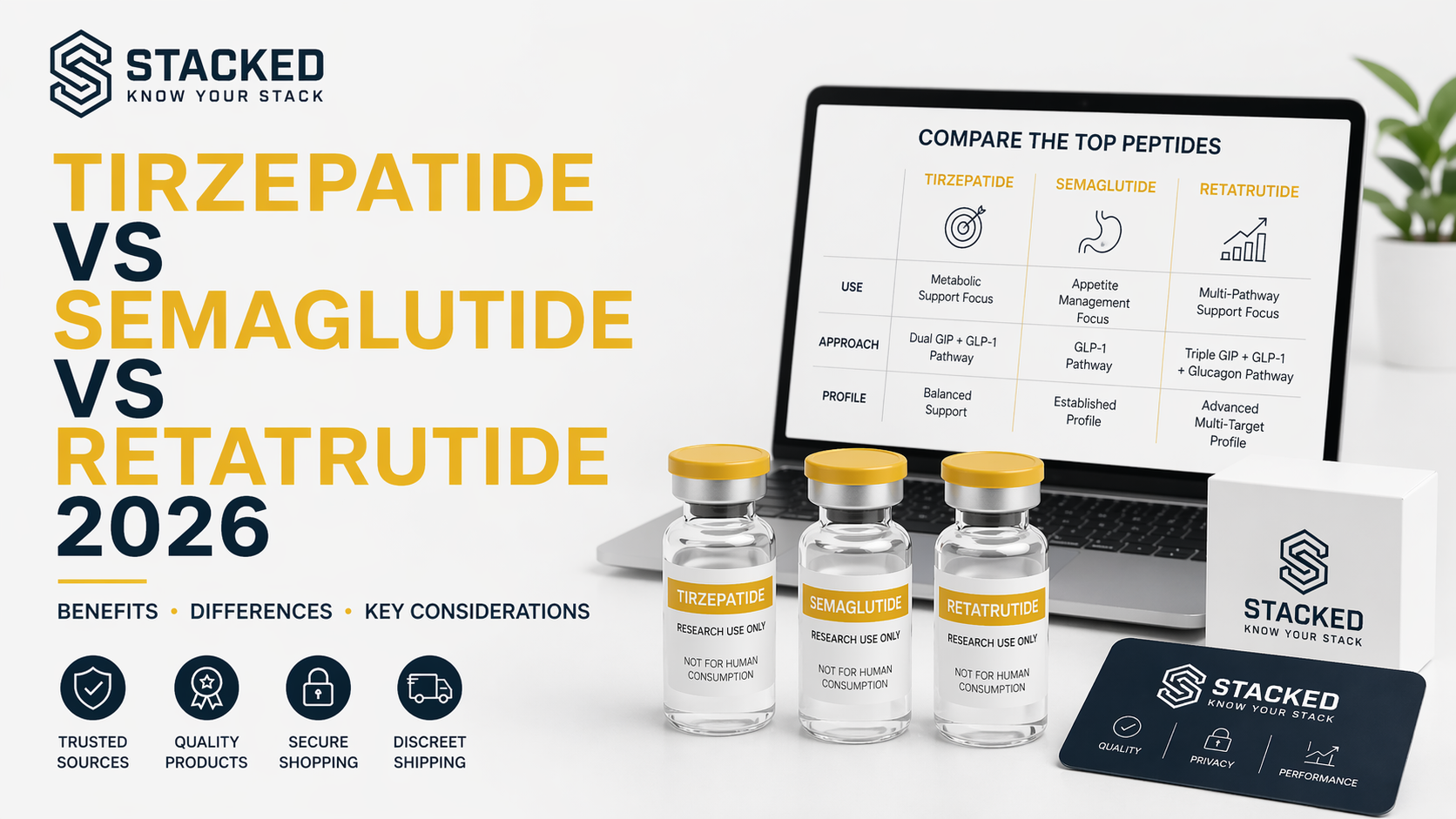
Tirzepatide vs Semaglutide vs Retatrutide: The Complete 2026 Comparison
The three GLP-1 class peptides dominating the weight-loss conversation, compared head-to-head on mechanism, trial efficacy, side effects, availability, and cost.
TL;DR, Short answer
- Semaglutide: ~15% mean weight loss at 2.4mg weekly over 68 weeks (STEP-1). FDA-approved (Wegovy, Ozempic, Rybelsus). Proven cardiovascular outcome data (SELECT: ~20% MACE reduction).
- Tirzepatide: ~20% mean weight loss at 15mg weekly over 72 weeks (SURMOUNT-1). FDA-approved (Mounjaro, Zepbound). Dual GIP/GLP-1 agonism.
- Retatrutide: ~24% mean weight loss at 12mg weekly over 48 weeks (Phase 2, Jastreboff 2023). Not FDA-approved, Phase 3 trials ongoing. Tri-agonist (GLP-1 + GIP + glucagon).
- All three are prescription-only. Research-chemical sources are not pharmaceutical-grade and are not appropriate for self-administration.
Trade-off in one line: Retatrutide has the largest Phase 2 weight loss but is still investigational; Tirzepatide is the most potent FDA-approved option; Semaglutide is the best-characterized, insurance-friendliest choice with the strongest cardiovascular evidence.
Why This Comparison Matters
GLP-1 receptor agonist weight loss is the single largest pharmaceutical story of the decade. In under eight years the class has moved from a niche type-2 diabetes therapy to a generational obesity intervention, and the three molecules people search for most, Tirzepatide, Semaglutide, and Retatrutide, now occupy distinct spots on the efficacy curve.
They are not interchangeable. Semaglutide is a single-receptor GLP-1 agonist with the deepest real-world dataset and a published cardiovascular outcome trial. Tirzepatide stacks GIP onto GLP-1 and delivers meaningfully larger weight loss in head-to-head data. Retatrutide adds glucagon on top of both and has produced the largest Phase 2 weight-loss numbers ever reported for an incretin, but remains investigational.
This post is grounded in published Phase 2 and Phase 3 trial data, not marketing. Every efficacy claim below is tied to the specific trial it comes from, with PubMed IDs where available. Our goal for anyone researching a tirzepatide vs semaglutide vs retatrutide decision is a rigorous side-by-side, not a sales pitch for any one molecule.
All three require a prescription. Stacked does not sell peptides and does not recommend self-administration of GLP-1 class compounds outside a supervised medical context.
The Three Peptides, At A Glance
| Peptide | Receptor Targets | Weight Loss (peak) | FDA Status | Frequency |
|---|---|---|---|---|
| Semaglutide | GLP-1 | ~15% at 2.4mg (STEP-1, 68 wk)1 | Approved, Wegovy (obesity 2021), Ozempic (T2D 2017), Rybelsus (oral T2D) | Weekly SC |
| Tirzepatide | GIP + GLP-1 | ~20% at 15mg (SURMOUNT-1, 72 wk)2 | Approved, Mounjaro (T2D 2022), Zepbound (obesity 2023) | Weekly SC |
| Retatrutide | GLP-1 + GIP + glucagon | ~24% at 12mg (Phase 2, 48 wk)3 | Not approved, Phase 3 ongoing (Eli Lilly) | Weekly SC |
Semaglutide, The Proven Workhorse
Semaglutide is a long-acting GLP-1 receptor agonist with roughly 94% structural homology to native human GLP-1 and a fatty-acid side chain that extends its half-life to approximately one week. It enhances glucose-dependent insulin secretion, suppresses glucagon, delays gastric emptying, and acts on hypothalamic appetite centers.
Approval timeline. Semaglutide is the most widely-used GLP-1 on the planet. It is approved under three brands:
- Ozempic (subcutaneous, T2D, 2017)
- Rybelsus (oral T2D, 2019)
- Wegovy (subcutaneous, chronic weight management, 2021)
Pivotal efficacy, STEP-1. The STEP-1 trial (Wilding et al. 2021, NEJM, PMID 33567185) randomized 1,961 adults with overweight or obesity to 2.4mg weekly semaglutide or placebo for 68 weeks alongside lifestyle intervention. Mean weight loss was approximately -14.9% on semaglutide versus -2.4% on placebo. Roughly 50% of participants achieved ≥15% loss.
Cardiovascular outcomes, SELECT. The SELECT trial (Lincoff et al. 2023, NEJM, PMID 37952131) enrolled 17,604 adults with overweight/obesity and established cardiovascular disease without diabetes. Semaglutide 2.4mg weekly reduced major adverse cardiovascular events (cardiovascular death, non-fatal MI, non-fatal stroke) by approximately 20% over a mean follow-up of 39.8 months. This is the first cardiovascular outcome data for an anti-obesity drug in people without diabetes, and it sets semaglutide apart from the other two molecules in this post.
Side effects and contraindications. GI side effects dominate the profile: nausea, vomiting, diarrhea, and constipation are typical, mostly titration-related. Rare events include pancreatitis, gallbladder events, and acute kidney injury in dehydrated patients. The class boxed warning regarding thyroid C-cell tumors in rodents applies. Contraindicated in personal or family history of medullary thyroid carcinoma, MEN2, pregnancy, and with a history of pancreatitis.
Clinical titration (reference only, prescription required). Clinical trials titrate every 4 weeks: 0.25 → 0.5 → 1.0 → 1.7 → 2.4mg weekly. Only prescribed, pharmaceutical-grade semaglutide is appropriate for use under medical supervision.
See the full Semaglutide profile and live semaglutide price comparison.
Tirzepatide, The Dual Agonist
Tirzepatide is a synthetic dual agonist of the GIP (glucose-dependent insulinotropic polypeptide) and GLP-1 receptors. The dual mechanism is why it outperforms single-agonist GLP-1s head-to-head: GLP-1 activity drives appetite suppression and glucose-dependent insulin release, while GIP activity enhances insulin sensitivity, modulates adipose tissue lipid handling, and may blunt some of the GLP-1-mediated GI signaling at equivalent levels of appetite suppression.
Approval timeline.
- Mounjaro (subcutaneous, T2D, 2022)
- Zepbound (subcutaneous, chronic weight management, 2023)
Pivotal efficacy, SURMOUNT-1. The SURMOUNT-1 trial (Jastreboff et al. 2022, NEJM, PMID 35658024) randomized 2,539 adults with obesity (without diabetes) to 5, 10, or 15mg tirzepatide weekly versus placebo for 72 weeks. Mean weight loss at the 15mg dose was approximately -20.9%, with ~57% of participants losing ≥20% of body weight. In the T2D SURPASS-1 trial (Rosenstock et al. 2021, Lancet, PMID 34186022) tirzepatide reduced HbA1c by approximately 2.0-2.4 percentage points at higher doses.
Why dual agonism might outperform. The prevailing hypothesis is that GIP receptor activation, particularly in CNS regions involved in energy balance and in adipose tissue, adds weight-loss potency beyond pure GLP-1 agonism while partially offsetting nausea. Whether the mechanism is primarily central, peripheral, or both is still an active research question.
Side effects. Largely mirror semaglutide's GI profile: nausea, diarrhea, vomiting, constipation, mostly titration-related. Hypoglycemia risk increases when combined with sulfonylureas or insulin. Rare pancreatitis and gallbladder events. Same class boxed warning for rodent thyroid C-cell tumors.
Contraindications. Personal or family history of medullary thyroid carcinoma, MEN2, pregnancy, severe gastroparesis.
Clinical titration (reference only, prescription required). Trials titrate every 4 weeks to maintenance doses of 5, 10, or 15mg weekly. Only prescribed, pharmaceutical-grade product is appropriate for use under medical supervision.
See the full Tirzepatide profile and live tirzepatide price comparison.
Retatrutide, The Triple Agonist (Investigational)
Retatrutide (development code LY3437943) is an investigational synthetic tri-agonist of the GLP-1, GIP, and glucagon receptors developed by Eli Lilly. Preserved GLP-1 activity buffers what would otherwise be glucagon's hyperglycemic effect, while glucagon receptor activity is hypothesized to drive increased energy expenditure and hepatic fat mobilization, effects GLP-1-only and GIP/GLP-1 agents do not produce to the same degree.
Status. Not FDA-approved. Phase 3 trials (TRIUMPH program) are ongoing as of 2026. There is no approved pharmaceutical-grade formulation.
Pivotal efficacy, Phase 2 obesity. The Phase 2 trial (Jastreboff et al. 2023, NEJM, PMID 37366315) randomized 338 adults with obesity to placebo or 1, 4, 8, or 12mg weekly retatrutide for 48 weeks. Mean weight loss at the 12mg dose was approximately -24.2%, the largest seen to date for any incretin-class agent in a published trial. The T2D Phase 2 trial (Rosenstock et al. 2023, Lancet, PMID 37366672) showed HbA1c reductions of ~2.0 percentage points at the 12mg dose with weight loss in the same cohort exceeding 16%.
Hepatic fat reduction, MASLD data. A Phase 2 MASLD/NAFLD sub-study (Sanyal et al. 2024) reported liver fat content reductions exceeding 80% at higher doses over 48 weeks, an effect attributable to both weight loss and direct glucagon-mediated hepatic lipid oxidation.
Side effects. GI-heavy like the rest of the class, and dose-dependent. A distinct signal observed in Phase 2 is transient heart rate elevation at higher doses (mean ~6-11 bpm at 8-12mg), attributable to glucagon agonism. Pancreatitis signals have been reported but remain rare. Long-term safety data is pending.
Contraindications. Personal or family history of medullary thyroid carcinoma, MEN2, pregnancy and lactation, history of pancreatitis.
Access caveat. Retatrutide is available only through enrolled clinical trials until FDA approval. Research-chemical listings of "retatrutide" sold online are not pharmaceutical-grade, have not been through the same quality and purity testing required for investigational drug product, and are not appropriate for self-administration. We include research-use pricing further down for completeness, but emphasize that a prescribing physician and clinical context are prerequisites for any human use.
See the full Retatrutide profile and live retatrutide price comparison.
Head-to-Head Efficacy Table
| Metric | Semaglutide | Tirzepatide | Retatrutide |
|---|---|---|---|
| Peak weight loss (%) | ~15% | ~20% | ~24% |
| Weeks to peak | 68 | 72 | 48 |
| HbA1c reduction (T2D) | ~1.5-1.8 pp (SUSTAIN) | ~2.0-2.4 pp (SURPASS-1) | ~2.0 pp (Phase 2) |
| Hepatic fat reduction | Modest, secondary to weight loss | Moderate (~30-40% in sub-studies) | >80% at higher doses (Sanyal 2024) |
| Cardiovascular outcome data | Yes, ~20% MACE reduction (SELECT, 2023)4 | Not yet reported (SURPASS-CVOT ongoing) | None, Phase 3 ongoing |
| Pivotal trial (weight loss) | STEP-1 (NEJM 2021, PMID 33567185) | SURMOUNT-1 (NEJM 2022, PMID 35658024) | Phase 2 (NEJM 2023, PMID 37366315) |
| Approval status | FDA-approved | FDA-approved | Investigational |
| Administration | Weekly SC | Weekly SC | Weekly SC |
| Dosing range (trial) | 0.25 → 2.4mg | 2.5 → 15mg | 2 → 12mg |
| Receptor targets | GLP-1 | GIP + GLP-1 | GLP-1 + GIP + glucagon |
Side-Effect + Tolerability Comparison
All three share the GLP-1 class GI signature, nausea, vomiting, diarrhea, and constipation dominate, are dose-dependent, and are most common during titration. Across pivotal trials roughly 40-70% of participants reported at least one GI adverse event at some point in the trial; severe or treatment-discontinuing GI events run ~3-7%.
Several class-level risks apply to all three:
- Pancreatitis. Rare signal, not definitively causal, but case reports exist across all three. History of pancreatitis is a contraindication.
- Gallbladder events. Cholelithiasis and cholecystitis reported at higher rates than placebo, driven in part by rapid weight loss.
- Medullary thyroid carcinoma (MTC). Boxed warning on the FDA-approved labels based on rodent C-cell tumor findings. No confirmed human signal to date, but personal or family history of MTC and MEN2 are absolute contraindications across the class.
Retatrutide's distinct signal is transient heart rate elevation at 8-12mg doses, likely mediated by glucagon receptor activation. Mean elevation observed in Phase 2 was modest but consistent, and long-term cardiovascular implications in obesity are pending Phase 3 readout.
Practical tolerability. If a patient is GI-sensitive or on their first GLP-1 exposure, clinical practice typically starts with semaglutide at 0.25mg weekly, the lowest intentionally sub-therapeutic dose, to acclimate the gut. Tirzepatide at 2.5mg is also a conservative first exposure. Retatrutide Phase 2 started at 2mg and still produced substantial early nausea at higher titration steps. Titration speed, not just dose, drives tolerability.
Contraindications, Who Should NOT Use These
Based on the FDA labels for semaglutide and tirzepatide and Phase 2 exclusion criteria for retatrutide, the following are contraindicated or require extreme caution across the class:
- Personal or family history of medullary thyroid carcinoma (MTC)
- Multiple Endocrine Neoplasia syndrome type 2 (MEN2)
- Pregnancy or lactation (or plans to conceive within the dosing period)
- History of pancreatitis
- Severe gastroparesis (GLP-1s slow gastric emptying further)
- Acute or chronic pancreatic disease
- Diabetic retinopathy with rapid glycemic correction (monitor closely)
- Eating disorder history with restrictive features
- Known hypersensitivity to any component of the formulation
This is not a comprehensive list. Every prescribing decision is individualized. Consult a prescribing physician, particularly for patients on insulin or sulfonylureas, where hypoglycemia risk rises on any GLP-1.
What About Cagrilintide and CagriSema?
Cagrilintide is a long-acting amylin analog, not a GLP-1. Amylin is co-secreted with insulin and acts on hypothalamic amylin receptors to slow gastric emptying, suppress glucagon, and reduce food intake through circuits largely distinct from GLP-1's. That distinct signaling is why it stacks additively.
CagriSema, co-formulated cagrilintide + semaglutide 2.4mg, is the most clinically-advanced amylin/GLP-1 combo. The Phase 2 readout reported ~15-17% weight loss and the REDEFINE-1 Phase 3 trial (Garvey et al. 2024) reported approximately 22% weight loss at 68 weeks, approaching tirzepatide-level efficacy without the GIP component.
Cagrilintide is not a tri-agonist replacement for retatrutide, it adds a parallel mechanism (amylin) rather than stacking another incretin receptor. For practical purposes it extends semaglutide's efficacy ceiling. See the full Cagrilintide profile.
Cost Comparison, Research-Use Market in 2026
Important caveat. The prices below are scraped from research-chemical vendors, not pharmacies. Pharmacy-dispensed Wegovy, Zepbound, Ozempic, and Mounjaro range from ~$900-$1,350 per month without insurance; compounded semaglutide and tirzepatide through telehealth routes range from ~$150-$500 per month. Research-chemical pricing is only relevant to laboratory investigators working in a research context, not for self-administration. The research-chemical market is also not pharmaceutical-grade, purity, sterility, and peptide identity are vendor-dependent and not FDA-regulated.
With that stated, the lowest per-mg research-use pricing across our three vetted vendors in 2026 is approximately:
| Peptide | Lowest $/mg | Lowest-price vendor (SKU) |
|---|---|---|
| Tirzepatide | ~$3.93/mg | Ascension Peptides, T-30 Kit (300mg, $1,180) |
| Semaglutide | ~$8.50/mg | Ignite Peptides, GLP-1 (S) 20mg ($170) |
| Retatrutide | ~$6.17/mg | Ascension Peptides, R-30 Kit (300mg, $1,850) |
Live pricing across all three of our tracked vendors is maintained on our Price Tracker, and individual dedicated pages at /price/tirzepatide, /price/semaglutide, and /price/retatrutide are updated twice daily.
Notable 2026 market observations.
- Tirzepatide research pricing has compressed substantially year-over-year as GLP-1 manufacturing scales, $/mg is now roughly half where it was in 2024.
- Semaglutide research pricing has actually risen in some vendor channels as regulatory scrutiny on compounded semaglutide has pulled supply tighter.
- Retatrutide research-chemical pricing remains volatile because there is no approved reference product, and published purity data is inconsistent across vendors.
Which Should You Choose? (Decision Tree)
A decision in this category is fundamentally a physician-patient conversation. The simplified decision tree below is framed for readers researching their options before that conversation, not as medical advice.
- If you want an FDA-approved option with insurance coverage and proven cardiovascular benefit → Semaglutide (Wegovy for obesity, Ozempic for T2D). Best-characterized safety profile, only molecule here with published MACE reduction data.
- If you want an FDA-approved option and are pushing for maximum weight loss under current labels → Tirzepatide (Zepbound for obesity, Mounjaro for T2D). Higher peak weight loss than semaglutide, head-to-head SURMOUNT data supports this.
- If you are first-time on the class and GI-sensitive → Semaglutide at 0.25mg weekly is the most conservative starting point. Tirzepatide 2.5mg is a close second.
- If metabolic-associated liver disease (MASLD/MASH) is a primary concern → Retatrutide has the strongest hepatic fat reduction signal (Sanyal 2024, >80%), but only inside a clinical trial context. Survodutide (Boehringer) and tirzepatide also have meaningful hepatic data and are further along regulatorily.
- If you're looking at Retatrutide outside a clinical trial → You shouldn't be. Until FDA approval, Retatrutide is investigational. Enrollment in an active Phase 3 trial is the only appropriate path to supervised access.
- If you're considering stacking → CagriSema (cagrilintide + semaglutide) is the most data-backed combo. Combining FDA-approved GLP-1s with each other, or with retatrutide, is not clinically validated and is not something we endorse.
Final note, repeated for emphasis. All three, semaglutide, tirzepatide, and retatrutide, require a prescription. Non-prescribed research-chemical sources are not pharmaceutical-grade, are not FDA-quality-controlled, and are not appropriate for self-administration. GLP-1 class peptides are only appropriate for use under medical supervision.
Research & Further Reading
- Jastreboff AM, et al. "Tirzepatide Once Weekly for the Treatment of Obesity" (SURMOUNT-1). NEJM 2022. PMID 35658024.
- Wilding JPH, et al. "Once-Weekly Semaglutide in Adults with Overweight or Obesity" (STEP-1). NEJM 2021. PMID 33567185.
- Lincoff AM, et al. "Semaglutide and Cardiovascular Outcomes in Obesity without Diabetes" (SELECT). NEJM 2023. PMID 37952131.
- Jastreboff AM, et al. "Triple-Hormone-Receptor Agonist Retatrutide for Obesity, A Phase 2 Trial." NEJM 2023. PMID 37366315.
- Rosenstock J, et al. "Efficacy and safety of a novel dual GIP and GLP-1 receptor agonist tirzepatide in type 2 diabetes" (SURPASS-1). Lancet 2021. PMID 34186022.
- Rosenstock J, et al. "Retatrutide in type 2 diabetes: a phase 2 trial." Lancet 2023. PMID 37366672.
- Sanyal AJ, et al. "Retatrutide for MASLD, Phase 2 hepatic-fat data." 2024.
See our full research methodology for how we evaluate trial evidence and vendor claims.
Affiliate disclosure. Stacked earns a commission on some purchases made through affiliate links in this post. Affiliate relationships do not influence our Stacked Score methodology, trial analysis, or recommendations. Full methodology at /methodology.
Legal & safety notice. For research purposes only. Not medical advice. Consult a qualified physician. GLP-1 class peptides (semaglutide, tirzepatide, retatrutide) require a prescription and are only appropriate for use under medical supervision. Research-chemical sources are not pharmaceutical-grade and are not appropriate for self-administration. Always verify any peptide against a pharmacist-dispensed reference standard before human use.
Footnotes
Related Peptides
Related Vendors
Liked this? Get the weekly signal.
New peptide deep dives, vendor score updates, and price-drop alerts. Published weekly. No spam.
For research purposes only. Affiliate links may be included.